Tier Manager provides a workflow-based way to configure and operate tier programs. It gives you control over how customers qualify for tier levels, earn or lose tier score, and retain or change their status over time. Every score change is recorded separately, making tier progression easier to trace, expiration easier to manage, and corrections easier to handle.
The Tiers module and Tier Manager cannot be enabled in the same workspace. Existing tier programs using the Tiers module remain operational. To switch to Tier Manager, contact the Antavo Service Desk.
How Tier Manager differs from the Tiers module
The Tiers module combines the tier structure with predefined progression, evaluation, and expiration logic.
Tier Manager separates these responsibilities and makes the runtime behavior configurable through Tier flows.
Tiers module | Tier Manager | |
|---|---|---|
Configuration model | Tier structure and tier behavior are configured as one tier system. | Tier structures define levels and thresholds, while Tier flows define customer enrollment, score changes, expiration, and level evaluation. |
Tier score storage | The customer's current tier score is stored as a single value that is rewritten when the score changes. | Every increase or decrease creates a ledger entry. The current tier score is the sum of active entries. |
Loyalty points and tier score | Tier progression is based on the point- or spend-based logic configured in the module. | Loyalty points and tier score are independent. A Tier flow determines which customer activities also change tier score. |
Tier level changes | Tier levels are updated according to the evaluation rules configured in the module. | A score change does not update the tier level automatically. Tier flows let you determine when the customer's score is checked against the thresholds and their level is updated. |
Expiration | Expiration follows the selected tier expiration model. | Expiration dates are stored on individual score entries, and a Tier flow explicitly evaluates when entries become expired. |
Tier level types | A tier structure uses a score-based or invitation-only qualification model. | Score-based and invitation-only levels can be combined in the same tier structure. |
Core concepts
Tier Manager is built from several components that work together but have different responsibilities.
Tier structures define the tier system, including its levels, qualification types, thresholds, and expiration settings.
Tier flows define and execute the processes that manage customer tier behavior.
Tier score ledger and snapshot record the resulting customer state.
The following concepts are used throughout the Tier Manager documentation:
Purpose | |
|---|---|
Tier structure | Defines the tier hierarchy, level types, score thresholds, and structure-level score and expiration settings. |
Tier flow | Defines how customers enter a tier structure, how their tier score changes, when score entries are evaluated for expiration, and when their tier level is recalculated. |
Tier score | A numeric value that represents the customer's current progress toward tier levels. It is separate from spendable loyalty points. |
Tier score entry | A separate record of a change that increases or decreases the customer's tier progress. It stores the amount of the change and its timestamp, can have an expiration date, and has an active or expired status. |
Tier level | The customer's current position in the ordered tier hierarchy. |
The customer's current tier score is calculated by adding together all active, non-expired tier score entries. An expiration date indicates when an entry becomes eligible to expire. The entry stops contributing to the current tier score only when the expiration logic configured in a Tier flow processes it.
Changing a customer's tier score does not automatically change their tier level. In Tier flows, you determine when customers are moved to the highest score-based level for which they have enough tier score. This allows score collection, expiration, and level evaluation to take place at different points in the customer journey.
To access the feature, open the Tier Manager module under the Modules menu. The module contains the following pages:
Tier structures: Create and manage tier systems, their levels, qualification types, and thresholds.
Tier flows: Create and manage the processes that control tier behavior.
Tier history: Review tier-related changes, score entries, and expiration information for a selected customer. Users with the required permission can also perform customer-level adjustments.
Access and permissions
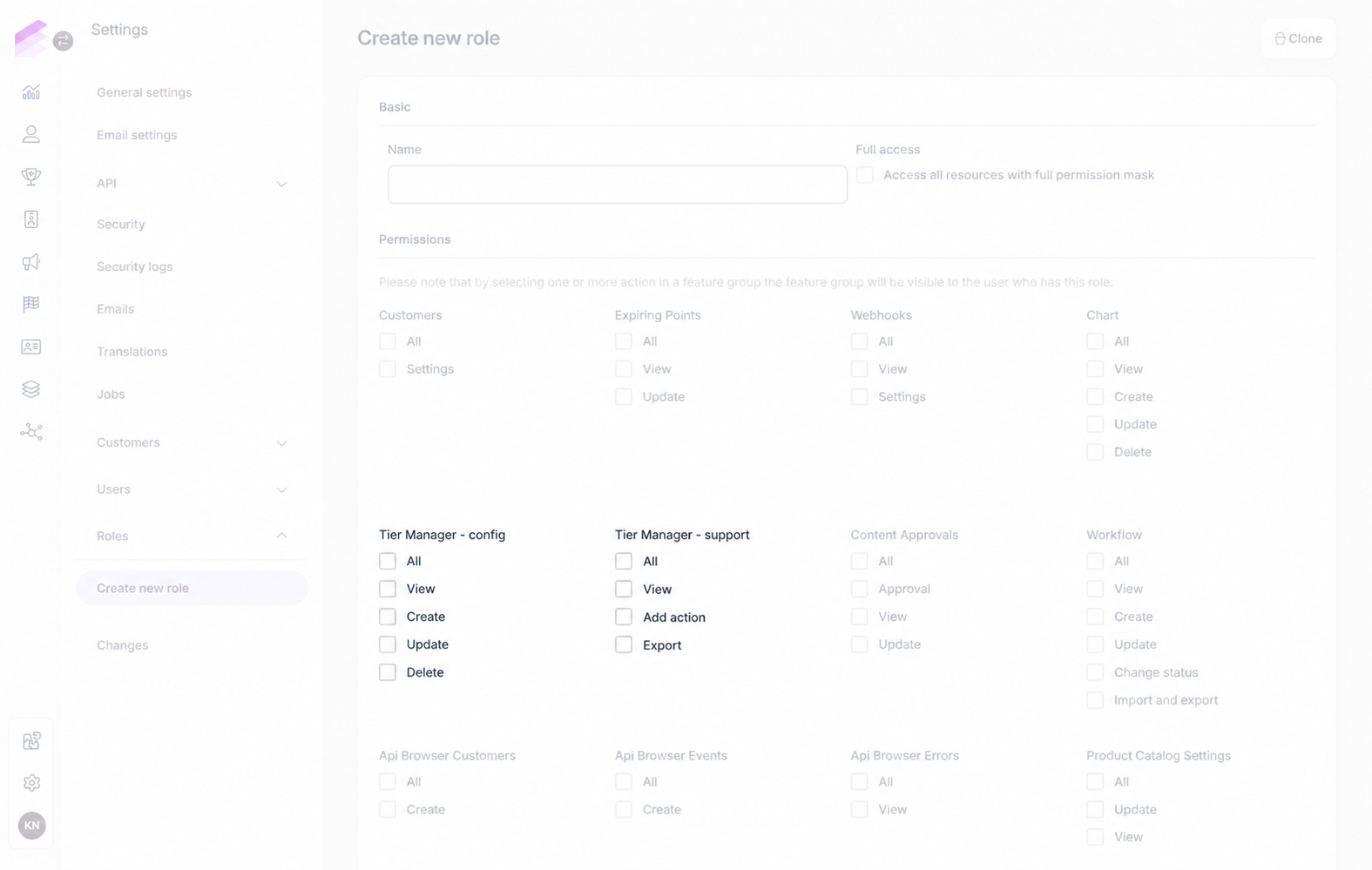
Tier Manager can separate the configuration access of the users of the Management UI through roles.
Tier Manager - config: Allows permitted users to create, update, and delete tier structures and Tier flows.
Tier Manager - support: Allows permitted users to view customer tier data and history and perform manual tier score or tier level adjustments, without changing the tier configuration.
The exact actions available to a user depend on the permissions assigned to their role.
Accessing tier information through APIs
Customer tier information is also available programmatically through Antavo's Customers API and the Loyalty Read API.
These endpoints let you access a customer's current tier state when integrating Tier Manager data with external systems.